
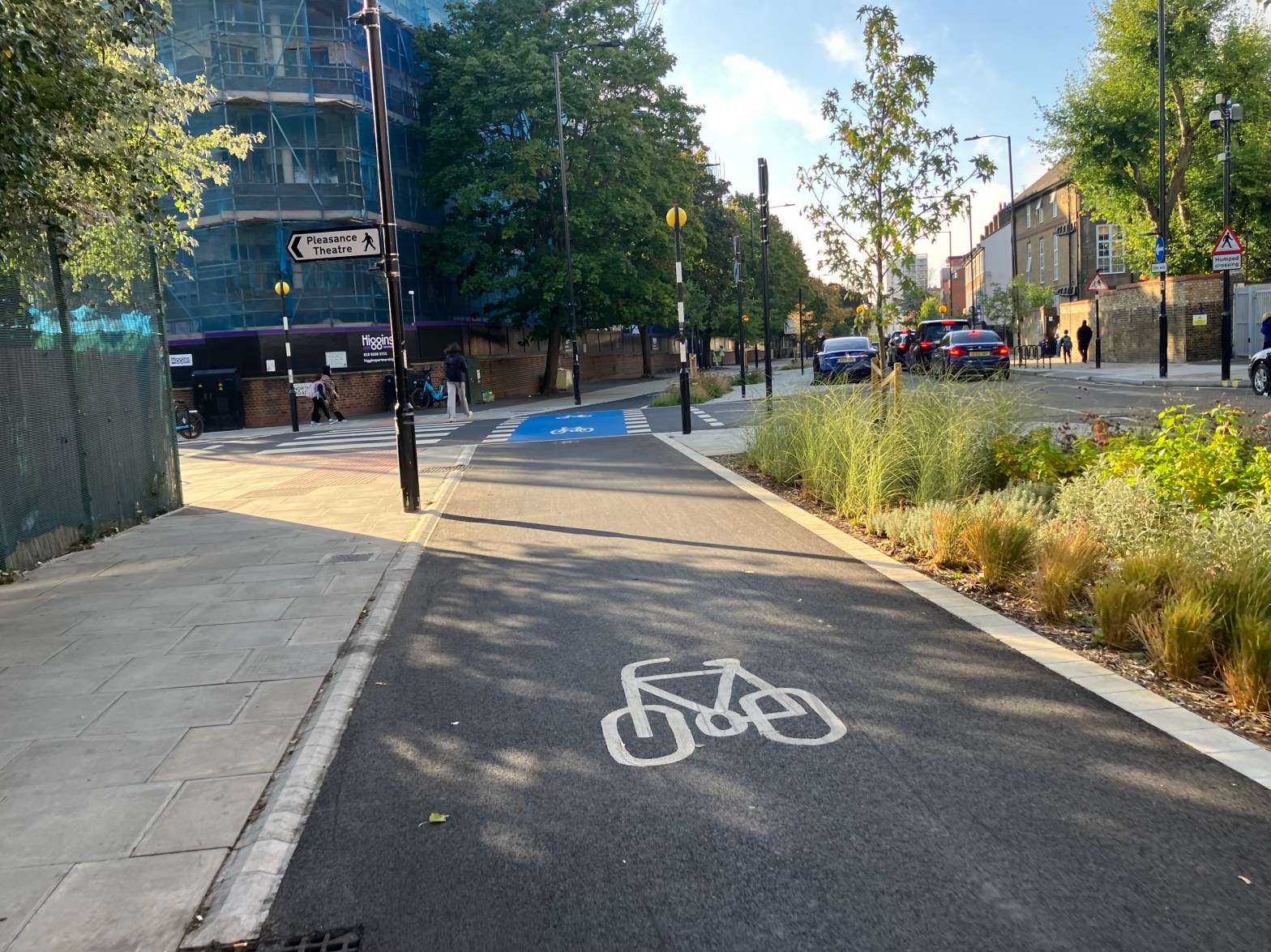
2025 has been the best year for new cycle infrastructure in London since the COVID-19 pandemic. This has seen not only the City of Westminster finally start its delivery of several transformative schemes, but also the construction of two new cross-river connections at Lambeth and Hammersmith, and the completions of two large projects, along the Royal Docks Corridor and on Deptford Church Street. However, perhaps 2025’s most significant development has been the breaking ground of four new large cycleways, all of which were promised and consulted on before the pandemic, but delayed due to Transport for London’s (TfL) subsequent financial difficulties.
To get an idea of what has been built and where, I suggest you first look at my 2025 New Cycle Infrastructure Map. On this you can see what was delivered last year, what is currently under construction (in brown), as well as compare 2025 to previous years, going back as far as 2020. I also suggest you watch Jon Stone’s Why 2026 will be amazing for cycling in London, which reviews the progress of each borough currently delivering healthy streets schemes.
City of Westminster
I’ve had a lot of bad things to say about Westminster in recent years. Occupying a massive part of central London, they’ve been a huge obstacle in creating a coherent and well-connected cross-city cycle network since the early 2010s (when TfL started to deliver safe routes). While Cycleway 3 was somehow pushed through – built between 2016 and 2018 – they’ve done almost nothing else of any significance, resulting in half of Zone 1 only having one good cycle route.
Since 2016, Londoners have been promised three quiet routes in the borough. These were approved by Westminster’s cabinet in 2019, delayed by the pandemic in 2020, and then when Labour took over in 2022, taken back to the drawing board and re-consulted. Now, with new and improved designs, the three routes have finally entered construction: C43 (Hyde Park to Marylebone), C51 (Marylebone to St John’s Wood) and C63 (Fitzrovia to Soho). While these cycleways aren’t perfect, following slightly indirect and un-intuitive routes, it’s great to see that after almost a decade, Westminster is finally building them.
Alongside this, the borough has completed the delivery of light segregation on Northumberland Avenue, Sussex Gardens (part of C27) and improvements around the Regent’s Canal in Little Venice. It also plans to start construction on several new protected cycle tracks in early 2026, such as Westbourne Terrace, Harrow Road, Abingdon Street and Portland Place. These are all incredibly important, because if we want a modal shift across the capital, central London has to be safe and accessible for cycling. After all, it’s where so many work, enjoy their leisure time, and of course, visit as tourists.
Other boroughs worth a mention
There are three other boroughs that deserve a mention due to the amount they’ve delivered this year:
LB Newham
Newham have been by far the best borough when it comes to delivering new cycle tracks, with massive progress made on the Romford Road extension of Cycleway 2, Westfield Avenue, the completion of the Royal Docks Corridor, and the start of work on Leyton Road (Cycle Future Route 7). Smaller improvements have also been seen with the upgrading of legacy cycle tracks on the Becton Corridor and the Lower Lea Crossing, and the completion of their part of the Jenkins Lane link, which creates a safe route between Cycleway 3 and Barking town centre.
LB Islington
Following the introduction of several low-traffic neighbourhoods (LTN) in 2020, the north London borough became rather timid, with only two LTNs going live between 2021 and 2024: St Mary’s Church (2022) and Bath Street (2023). This all changed in 2025, with the amazing delivery of the Mildmay LTN (near Dalston) and its associated segregated lanes: along Boleyn Road (part of Cycleway 1) and across Newington Green. They also started construction on St John’s LTN, which should go live in the coming months, and two safe crossings: one across Essex Road and another over Pentonville Road. Lastly, 2025 saw them finish their work with LB Camden on the York Way Cycleway, which now connects Kings Cross with Cycleway 50 in Holloway.
LB Lambeth
Despite financial difficulties, Lambeth has had their best year on LTN delivery since 2020, with four new areas created: Waterloo South, Vauxhall Pleasure Gardens, Stockwell Gardens and Voltaire Road. In central London, they’ve also closed Concert Hall Approach to vehicles, creating a pleasant new shared space between Waterloo Station and the Southbank Centre. And lastly, they’ve made progress on linking up existing infrastructure, with major steps made on the Streatham to Brockwell Park cycle route and the completion of their half of Lambeth Bridge.
The standout schemes of 2025
Royal Docks Corridor/Lower Lea Crossing
In 2025 LB Newham completed the Royal Docks Corridor that they’d started work on three years before. This provides an amazing, high quality link from London City Airport, through West Silvertown, past City Hall and up to Canning Town Station, where it connects to Cycleway 3. Alongside this, the completion of TfL’s controversial Silvertown Tunnel has resulted in another link from the Royal Docks up to Cycleway 3, via the Lower Lea Crossing. Taken together, these routes create an amazing network around the Royal Docks, ready to serve the several residential blocks currently under construction.
Deptford Church Street
With construction starting in late 2024, this wide, main-road cycle track provides a fantastic feeder route from Deptford town centre to the recently completed Cycleway 4. Like the Royal Docks Corridor, this is exactly the kind of scheme TfL should prioritise as it makes good use of existing and high-capacity main-road arterial cycleways.
Hammersmith Bridge
Following many years of construction work, Hammersmith Bridge has finally re-opened to cyclists and pedestrians. Although there’s a possibility that cars and buses might eventually be allowed back, everything the current government has insinuated so far suggests that money will not be made available any time soon. So therefore until then, this will be one of London’s most pleasant cycle routes, connecting Barnes to Hammersmith, providing connections to both Cycleway 9 and Cycleway 34.
Enfield Town to Broxbourne Cycleway (C20)
With the first phase delivered in 2024 and further phases set to be delivered by Broxbourne Council in 2026, this amazing route provides a pleasant riverside link between Enfield, Waltham Cross and Broxbourne. It’s also a great example of how London boroughs can collaborate with those just outside the capital, creating useful local links.
Big schemes finally under construction
2025 saw four ambitious main-road schemes enter construction that all pre-date the pandemic, with three of them even having roots in the original 2009 Cycle Superhighways Plan. These schemes will be transformative for the capital, creating essential main-road links between neighbourhoods. They also provide relief that TfL can begin to move on from these projects and start working towards the next ambitious main-road schemes.
Cycleway 4 East (Charlton-Woolwich)
A high-capacity cycle route between Tower Bridge and Woolwich was first announced in 2009. The Charlton-Woolwich section was consulted on in early 2020, but was put on the back burner while TfL resolved its post-covid financial issues. Finally in April 2025 work started, which when complete, will create over one and a half miles of new, high-quality, segregated cycleway. Also, with construction soon to start on a safe link across Greenwich town centre, by 2027, this scheme will form part of a seven mile-long, safe and protected continuous route all the way from Woolwich to Tower Bridge.
Nine Elms Lane (Vauxhall-Battersea Park)
This route was first consulted on in 2017. With a small section delivered in 2021, delays then occurred, partially due to surrounding construction, but also due to disputes over funding. Finally, eight years after its consultation, construction has now started in earnest, and should be complete next year. This mile-long route will create a safe protected cycleway between Vauxhall and Battersea, and will later be extended to meet Cycle Superhighway 8.
Cycleway 34: Wood Lane (Holland Park Roundabout- Du Cane Road)
This route first appeared in 2009 as part of a planned Cycle Superhighway between Kensington Olympia and Hanger Lane. Then in 2020, this section (along with proposed tracks heading east to Notting Hill) was consulted on. However, as the Royal Borough of Kensington and Chelsea refused to build their section, TfL and LB Hammersmith and Fulham had to build theirs alone. When complete, these new cycle tracks will create 1.25 miles of protected cycleway, connecting in the north to the existing Cycleway 34 (White City to North Acton). Apparently, it will also one day form part of a longer route between Wembley and Fulham, with other sections set to enter construction in 2027.
Streatham Hill (Clapham Park-Streatham Hill)
This route was first announced in 2017 and consulted on in 2020. Following many delays, construction finally started in summer and once complete, will be one of the highest quality cycleways in south London. Being just over half a mile long, it will connect to many LTNs in the area, while massively improving the streetscape along the traffic-chocked Streatham Hill. The long-term ambition is to connect this to CS7 at Oval, but don’t expect any action on that until the 2030s.
Other worthy mentions
There are a few unexpected things that happened this year that should also be mentioned. Firstly, LB Harrow started work on their first significant piece of cycle infrastructure in years, a route between Harrow and Pinner. This is all the more impressive given that by 2021, they’d removed all their pop-up infrastructure. Secondly, RBKC – the worst borough for cycling in London – have actually done a few things: an improved junction at the north end of Battersea Bridge (largely by force, following several tragic and unnecessary deaths); a new parallel crossing at the Brompton end of Quietway 15; and two new shared spaces on Bute Street and Draycott Avenue. Now this is in no way praise for the Royal Borough. They’re still dreadful. It’s simply noting the shock that these things actually made it through.
Conclusion
So in conclusion, a good year, especially for inner London that hasn’t seen much new infrastructure since 2020. However, the biggest achievement is the amount of new starts which will make 2026 amazing. This may be derailed slightly by the local elections, which could result in a few boroughs getting taken over by parties that are against healthy streets schemes. But all we can do is hope that the final results aren’t as bad as predictions currently suggest. Because with TfL’s finances finally improving, the second half of the 2020s could be pretty amazing with the right people in charge.
 SafeCycleLDN