
Follow this link for the accompanying map: https://www.google.com/maps/d/u/0/viewer?mid=1dzywA6k0CrBgQeYculZ6rxZ92lCyvio&ll=51.511623245437306%2C-0.14341749999998932&z=10
Since the lockdown years of 2020/2021 (when councils and TfL constructed pop-up cycleways/LTNs here, there and everywhere), the delivery of new cycleway/low-traffic neighbourhood projects has been slow, with the year-on-year delivery in 2022, 2023, and now 2024, being markedly less than the three years before the pandemic. With a cash-starved TfL and press backlash over the Covid-era pop-up schemes, councils and TfL have delivered everything in painfully slow dribs and drabs.
However, one of the big achievements of this year has been that several large schemes (that were slowly being built in phases) have finally been finished, creating several amazing new routes across the city. The most notable of these are:
- The Lower Road section of Cycleway 4, which now allows for a continuous segregated route between Tower Bridge and Greenwich. This is amazing since it was consulted all the way back in 2017, with construction starting two years later in 2019.
- The Islington section of Cycleway 50, which now allows for a safe route between Camden (C6) and Finsbury Park
- The final section (annoyingly bar the Dalston LTN) of Cycleway 23’s western extension, creating a high-capacity link from LB Waltham Forest’s Mini Holland network to the rest of London, linking to Cycleway 1 at Dalston
- The extension of Cycleway 9 to Brentford town centre, creating a continuous safe(ish) route from Hammersmith to Brentford, via Turnham Green. Like C4, this was first consulted on in 2017, with construction also starting just before the pandemic.
Seeing all the above routes finally complete is transformative. No longer when using these cycleways will you be suddenly dropped onto a dangerous main road in the middle of a half built route which has been under construction in many cases since before the pandemic.
– – –
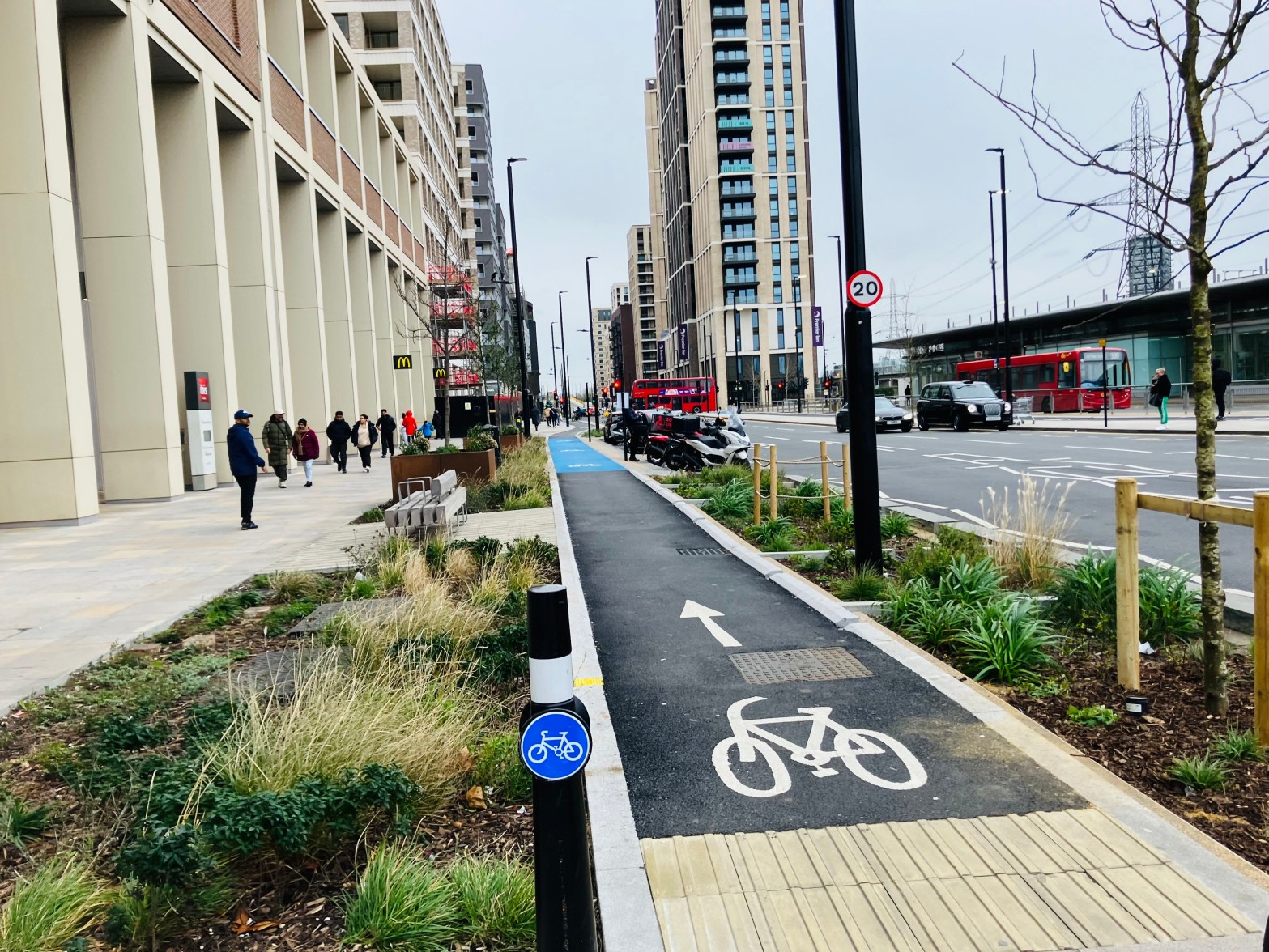
Regarding new cycleways of considerable length, the standout is the partially complete North Woolwich Road, which creates a high-quality route from Canning Town (C3) to City Hall, with the next section to London City Airport, currently under construction. The other significant project has been the completion of the Kensington Road cycleway in Northolt, delivered by LB Ealing as part of their Levelling-up bid. The works on Church Road/Mandeville Road, part of the same scheme, are still ongoing.
Other than these, there have been several small projects across the capital, although far less than there should be. After all, building a great city for cycling means not only big capital projects, but also hundreds of small interventions. Of these, the ones that stand out are:
- Bank Junction: this five-legged traffic interchange has seen several tragic casualties in recent years. Since Covid the City has restricted vehicle use at certain hours. However now, with the permanent work complete, it creates wider restrictions. This includes making the east end of Queen Victoria Street a cul-de-sac, except for cyclists, and building a segregated bike lane on the west end of Threadneedle Street. The scheme is particularly good, as it doesn’t only improve things for cyclists and pedestrians, but also bus journey times. Sadly, more recently, the City has caved in and decided to allow black cabs use the junction again. This reduces the benefits.
- Holborn Gyratory: another dangerous central London junction with a sad history of cyclist casualties. With the first section delivered in 2022, LB Camden have now installed a unidirectional cycle lane on Drake Street and a cycle gate on High Holborn. With TfL’s finances now in better shape, the next phase will hopefully see the full delivery of the Holborn Liveable Neighbourhood, completely reordering this gyratory to make it safer for cyclists and pedestrians.
- LB Enfield Mini Holland: Enfield continue to deliver on their Mini-Holland works, with the first phases of the Enfield to Broxbourne and Enfield to Ponders End Cycleways being built, the start of works on the Enfield Liveable Neighbourhood and the completion of the Brownlow Road crossing in the south of the borough. Hopefully the next few years will see the completion of these schemes and more.
Lastly, low-traffic neighbourhoods. This has seen a small drop from 2023, especially with the loss of Streatham Wells in Lambeth. However, there have been a few standouts worth mentioning. These include:
- Somers Town: this long-awaited LTN removes through-traffic and pollution from one of London’s most deprived areas. It also improves cycle-safety on the historic Camden-Bloomsbury cycle route (LCN6) and TfL’s Cycleway 41 to Euston.
- Oval: this LTN improves safety outside Oval Cricket Ground and Henry Fawcett Primary School. Alongside this it improves some of the routes identified on TfL’s Central London Grid.
- West Ham Park: Newham is really turning a page when it comes to safe streets. This LTN will make journeys safer in an area, which up to now, has been commonly used for rat running.
Although these yearly summaries generally end with a look to the future, before we get there, it feels important to highlight boroughs who have promised a lot and delivered little:
- Firstly Westminster: the new Labour administration came into power with a bang in 2022, promising a new start when it came to cycling. They created a website titled Westminster Cycleways, put out numerous consultations and made improvements on cycleway designs drawn up by the previous administration. However, with the exception of the TfL-led Lambeth Bridge, we’ve seen virtually nothing: with only a vague mention this month that the promised schemes should be delivered from the 2025/26 financial year onwards. We can only hope they actually mean this, because if they don’t get their act together soon, we’ll reach the end of the 5-year political cycle and they could easily go into the next election having achieved nothing.
- Secondly Wandsworth: another new Labour administration from 2022, but even worse. In 2021, Wandsworth was on the eve of constructing the TfL-led Nine Elms Lane cycle tracks. They also had two other cycleways in the pipeline on Burntwood Road and Queenstown Road. Yet since 2022, Burntwood Road has been slimmed down to not much more than paint on the road and Queenstown Road and Nine Elms Lane have been severely delayed. Rumor has it construction is finally set to start on the latter two in early 2025, although I’ll believe it when I see it.
- Thirdly, LB Southwark: historically one of the better boroughs in London, Southwark celebrated the start of the year with the completion of Cycleway 4’s Lower Road section. However, other than this, there seems to be a blockage: no new LTNs, no progress on C17, C35 or C36, and lastly nothing on the 11 years-in-the-waiting Southwark Spine, which has seen no genuine progress since early 2021. One would hope that in 2025, they finally get their act together and get some shovels in the ground
- Lastly, LB Hackney: for a borough which has some of the highest cycling numbers in the country, they sure like to drag their feet. Despite finally completing C23’s western extension and making permanent the Queensbridge Road tracks north of the Regent’s Canal, this London borough have ostensibly paused their LTN programme and are bringing forward two schemes that although improve things for pedestrians, leave things the same (or worse in some cases) for cyclists: Downham Road and Pembury Circus. Hopefully they’ll come to their senses in the coming years and realise that they can (and must) do better.
Looking forward to next year, the recent funding announcements for the 2025-28 Local Implementation Plan (LIP) and delivery dates mentioned in cabinet papers are promising. This should mean that 2025 will be the year where things finally pick up after the post-Covid slump, with over ten new LTNs likely to be delivered. Alongside this, the start of construction is scheduled for several large cycleway schemes, such as C34 (Wood Lane), Nine Elms Lane, the Streatham Hill Cycleway, C9 to Syon Park, and (God forbid), perhaps a few of Westminster’s proposals.
 SafeCycleLDN